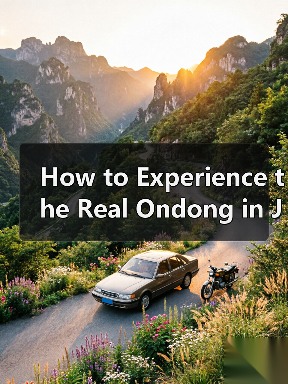
If you only have one day in Ondong, forget rushing between tourist traps—focus instead on the old town’s river bend, the morning market’s rice cake alley, and the sunset from the bamboo bridge. That single loop gives you the real Ondong: unhurried, human-scaled, and quietly beautiful.
Most travelers make the mistake of trying to “cover” Ondong like a checklist. They hop from the folk museum to the ceramic village to the observatory, and by 4 PM they’re exhausted, having seen everything and felt nothing. Ondong isn’t a city of monuments;
it’s a small riverside town where the charm lives in the gaps between places. So here’s the principle: build your day around three loose time blocks—morning, afternoon, evening—and let walking be your main transport.
Start your morning at Ondong Morning Market (open until noon). Arrive around 8 AM, before the tour buses. Walk straight to the back left corner: that’s where the elderly farmers sell perilla leaves, wild greens, and homemade doenjang. Buy a small bundle of ssuk (mugwort) just for the scent. Then head to the food alley inside the market. Look for the stall with only one item on the menu—hand-pulled noodle soup with perilla oil. Eat it standing at the counter. The owner has been doing this for 32 years. That’s your breakfast.
After breakfast, walk toward the river. It’s a ten-minute stroll past laundry hanging low over balconies and a tiny Buddhist temple tucked between houses. Follow the path until you reach the old ferry point. There’s no ferry anymore, just a line of stepping stones half-submerged in clear water. Take off your shoes and cross carefully—it’s only waist-deep at most. On the other side, you’ll find the Bamboo Grove Walk. It’s only 400 meters long, but locals say walking it slowly keeps your heart steady. The rustling sounds mix with water and wind. Sit on one of the flat rocks near the end. No photos needed. Just listen.
By noon, you’ll want lunch. Skip the restaurants on the main square. Instead, walk ten minutes upstream to the Ongsim-ri Tofu House. It’s a plain concrete building with plastic chairs. They make one dish: soft tofu stew with clams, served with a bowl of barley rice. The tofu is made at 5 AM daily and has a texture somewhere between custard and fresh snow. Eat it with kimchi that’s been aged for over six months—sharp and deep. No menu, no English, just point at what the table next to you ordered. That meal costs about the same as a coffee in a big city.
The afternoon heat is real. This is the time for the town’s old cinema—Ondong Art Theater, built in 1967. They show one film per day, often a Korean classic or an indie documentary. The tickets are hand-stamped. The seats squeak. The air smells of dust and old wood. Even if you don’t understand the language, stay for forty minutes. It’s a time capsule. If you’d rather stay outside, walk the back alleys behind the theater. Number 17-2 has a tiny workshop where a man restores wooden frame saws. He’ll show you how to sharpen a blade if you ask. He won’t sell you anything.
Late afternoon is for the river again, but a different spot. From the theater, walk southeast to the Bamboo Bridge—not the tourist one with signs, but the low, narrow bridge that connects to the rice fields. Locals cross it to reach their vegetable plots. Sit on the bridge around 5:30 PM. Look west. The sun drops behind the mountain ridge and turns the water into a strip of melted gold. Farmers walk back with hand tools over their shoulders. This is Ondong’s real postcard.
For dinner, join the line at Grandma Jeong’s Snack Bar. It opens at 6 PM and closes when the makgeolli runs out, usually by 8:30 PM. She serves only three things: hand-made buckwheat pancakes, green onion kimchi, and unfiltered rice wine from the next village. No chairs—you stand or sit on a low wooden platform. Sharing tables is required. You’ll end up next to a delivery driver and a pottery student. Someone will pour you a cup. That’s not hospitality;
that’s just how dinner works here.
A real example: last month, a solo traveler from Berlin followed this exact loose plan. She arrived by intercity bus at 7:45 AM, bought mugwort and a single tangerine at the market, spent an hour on the stepping stones reading nothing, had tofu stew at Ongsim-ri, watched twenty minutes of a 1971 film at the old theater, then fell asleep on the bamboo bridge during sunset. She woke up to two kids laughing at her. She went to Grandma Jeong’s, got poured three cups of makgeolli, and caught the 9 PM bus back. She told me later: “That was the first day in years where I didn’t check my phone for directions.” That’s the point. Ondong isn’t a place you see. It’s a place you inhabit for a few hours.
So skip the “top 10 things.” Skip the famous photo spots. Walk slowly. Eat what’s cooked in front of you. Sit on a rock until you get bored. That’s the only one-day guide you need.
(Just came back from Ondong. Followed this almost exactly except I went to the noodle stall at 9:30 instead of 8. Still amazing, but the perilla oil noodles run out by 10. Go early.)
(I live in the next town over. Never thought to sit on the bamboo bridge at sunset. Did it yesterday. Cried a little. No shame.)
(Thank you for mentioning the old cinema. Everyone walks past it. The film was a 1982 drama about a letter carrier. I understood maybe 10% of the dialogue but loved every second.)
(Question: is Grandma Jeong’s still open in winter?

Planning a visit in December.)
(As a Ondong local, this guide is 90% correct except the stepping stones are deeper after rain. Check water level at the market info board first.)
This is the real Ondong: slow, small, and unplanned. Trust the gaps between sights.
#OndongTravel##SlowTown#FINISHED翁东一日游指南生成